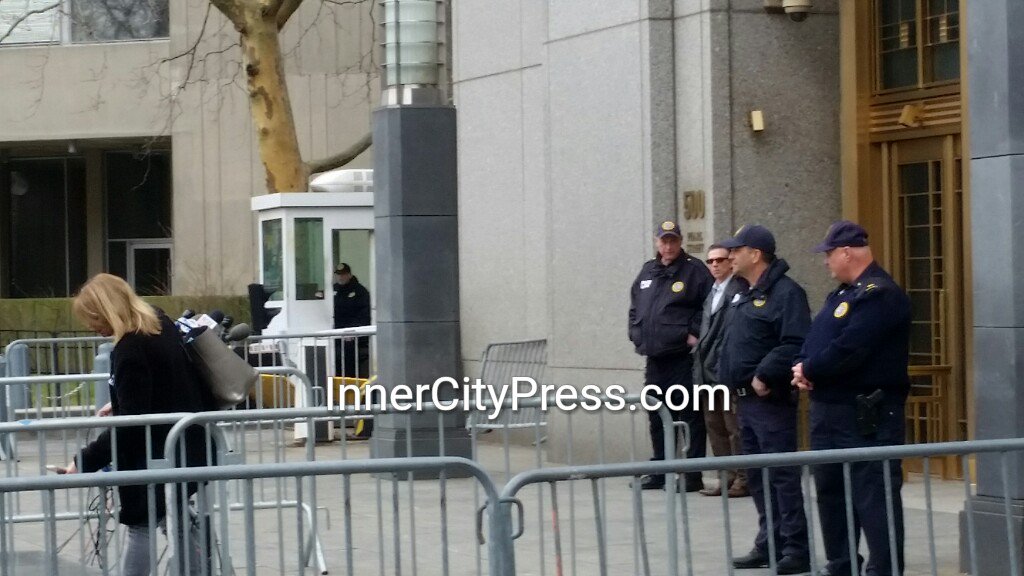
EDNY COURTHOUSE, Sept 17– On the
Eastern District of New York's public courtroom calendar
for July 7, 2026 was an entry with no name: "* SEALED *,"
2:00 p.m., Courtroom 6H North, before Judge William F.
Kuntz, II. On PACER, the case — 18-cr-277 — returns only
"Sealed v. Sealed. This case is under seal."
On July 13 Judge Kuntz set a schedule:
"ORDER: The Court is in receipt of the request from Inner
City Press to unseal the criminal case 18-CR-277. ECF No.
1. The Court DIRECTS Plaintiff and Defendant to submit
their responses to the request on ECF on or before
Tuesday, August 11, 2026, at 5:00 P.M. The Court further
DIRECTS Inner City Press to submit its reply, if any, on
or before Tuesday, August 25, 2026, at 5:00 P.M. The Clerk
of Court is respectfully directed to mail a copy of this
Order and an updated copy of the docket report for the
above-captioned civil action to Mr. Matthew Russell Lee of
Inner City Press. Ordered by Judge William F. Kuntz, II on
7/13/2026."
Inner City Press appeared. The AUSA and defense
counsel began at one table. Then when Judge Kuntz came in,
he ask the defense lawyer to move to the defense table -
then asked the AUSA to join him there.
Inner City Press spoke first, as movant,
and said it was impossible to know what Sealed v Sealed
was or is; there is no way to get NEF notices.
Reference was made to a transcript of July
7. But since there is not docket, it cannot be ordered. It
is, in effect, sealed. The AUSA cited personal
information, medical information, third party information
and law enforcement sensitive information.
Inner City Press those may be redacted, but must be
justified, as set forth on Lugosch and its own case, US v.
Greenwood. Judge Kuntz asked for the citation; it will be
provided in a memo of law on or before August 28.
It emerged that in Sealed v Sealed or US v John Doe cases, some administrative Federal body encourages judges to review these periodically. But how is the public to know?
On September 3 Judge Kuntz ruled: Criminal
Docket 18-CR-277 stays sealed, he says. His thirteen-page
opinion
accepts the government's assertion that specific,
on-the-record findings justifying continued secrecy were
made at a July 7 status conference — without ever stating,
in the opinion itself, what those findings actually were.
It accepts four generic categories — "personal
information, medical information, third-party information,
and law enforcement sensitive information" — as
sufficient, in the same opinion that quotes Lugosch v.
Pyramid Co. of Onondaga's own rule that "broad and general
findings by the trial court... are not sufficient to
justify closure."
And it never separately addresses whether
the docket sheet itself — as opposed to the documents
within it — meets the heightened standard Judge Kuntz's
own opinion quotes from Hartford Courant Co. v.
Pellegrino: that docket sheets matter precisely because,
without them, "the public cannot know what it is being
denied."
The opinion also contains something worth
sitting with regardless of the outcome: Judge Kuntz
disclosed, on the record, that he alone currently presides
over or has presided over approximately ninety cases
sealed this same way — "Sealed v. Sealed," invisible on
PACER, invisible on CourtListener — with comparable
numbers likely existing across other judges nationally.
Whatever the Second Circuit ultimately makes of this
specific docket, that number is the real story this case
surfaced. Inner City Press wants to appeal, and is (very)
actively seeking pro bono appellate counsel - DMs open : )
While still searching, Inner City
Press on September 17 took Judge Kuntz up on his challenge
to "come to the courtroom and see" or risk whole cases
disappearing. There was a change of plea scheduled in USA
v. John Doe.
Inside, a smallish Asian man sat at the defense in
a light blue parka and pink pants. When asked if he was
pleading guilty he merely nodded; the interpreter, sitting
next to him, said "Yes." She also read out his allocution,
to money laundering for narcotics trafficking from January
1, 2018 to December 31, 2025. The penalty is thirty years,
and Judge Kuntz said he was ordering a pre-sentencing
report in six months.
Then the AUSA said to adjourn that
indefinitely, and to seal the transcript. Judge Kuntz made
sure that the defendant's actually name had never been
mentioned, while saying that he was from China. Calling it
a close case (?) he agreed to seal the transcript of what
had ostensibly been an open court proceedings.
The appeal of In Re Inner City Press
is absolutely needed. Some law firms note they might be
conflicted, since they can't know the name of these
defendant in that case. But what about the big non-profit
press freedom and transparency groups, legal clinics, the
elite First Amendment bar? One is involved in a case about
Sean Combs; another partnering in the Northern District of
New York but not answering simply and polite emails. We'll
have more on this.